
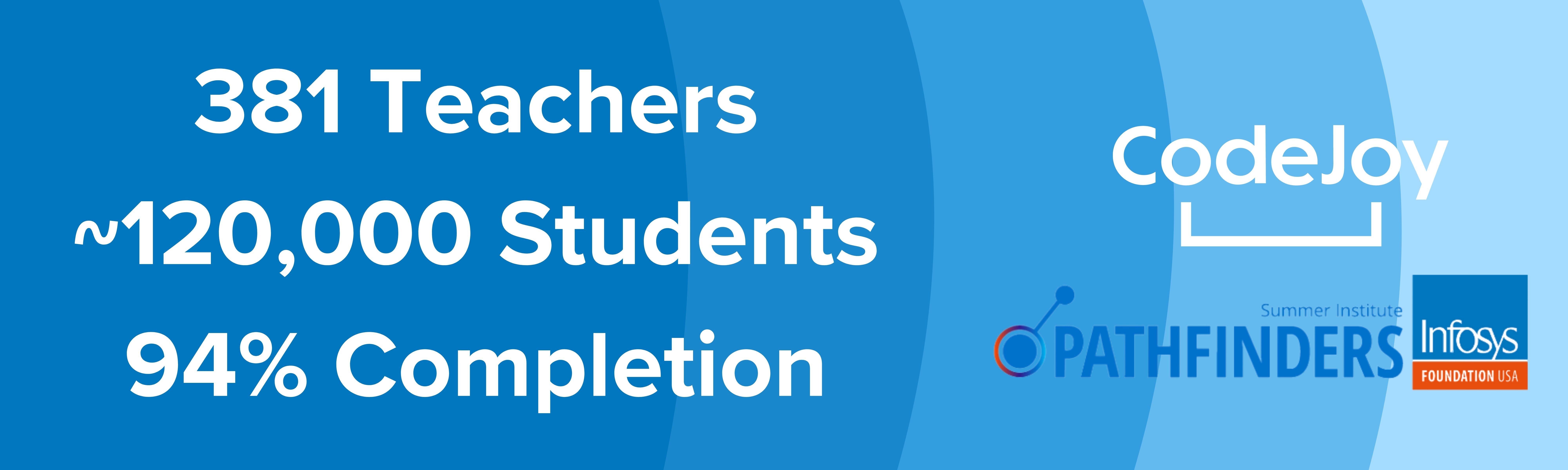
What a summer it’s been. Between June and August, the CodeJoy team ran five full Professional Development courses for the 2026 Pathfinders Summer Institute with Infosys Foundation USA — and 381 teachers, from Hawaii to Maine, showed up to learn coding, robotics, and AI on their own unpaid time.
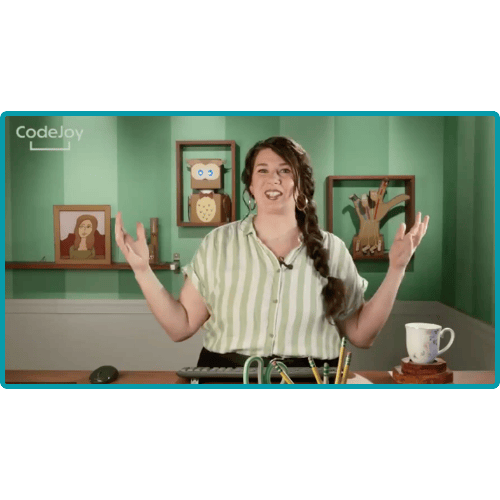


Let that sink in for a second. Most of these educators were never trained to teach computer science — it just isn’t their subject. They signed up anyway, around real summer lives: family emergencies, hospital stays, even a lightning strike that took out one teacher’s hardware kit (replaced without a second thought, obviously). And 94.39% of them finished. For context, most online courses — across any industry — see completion rates of 5% to 15%. That number doesn’t happen by accident; it happens because our team calls, emails, and checks in with every single educator from the moment they register to the moment they finish.
Five Courses, One Mission
This year’s lineup was our biggest and most varied yet — three returning favorites and two brand-new courses:
Coding Carnival — 109 teachers · 94% completion · ~53,000 students reached
Teachers turned the BBC micro:bit into a full-blown midway of games and illusions. Michelle Pergar from Southmoreland Elementary in PA said it best: “I am confident and excited to share these lessons with my classes thanks to your program!” Melissa Gilman put it more bluntly: “You can’t beat it… free materials and the chance to geek out on some coding.” And Natalie Mondesir has already made herself our best recruiter: “I have been telling everyone about CodeJoy and what they have to offer.”

I Heart Robots — 91 teachers · 93% completion · ~25,500 students reached
Our Hummingbird Robotics course, built around connection as much as circuitry, posted the strongest confidence effect size of the summer. Margaret Dominguez from Pflugerville ISD called it “my favorite summer PD! I do it on my own time because I learn so much and have fun doing it.” Cristina Castillo felt it too: “I love how CodeJoy transmits its love and passion for learning, which allows us teachers to feel that same energy when we are teaching the material.”

Playful AI — 21 teachers · 95% completion · ~5,300 students reached
Our smallest and most closely supported cohort posted the highest completion rate in the entire program. Tanya Churchill leaned on the asynchronous option to make it work: “The asynchronous options are a life saver… I look forward to CodeJoy being part of the Pathfinders grants every summer.” Brandy DelleDonne is already a repeat customer: “I have really enjoyed all of the CodeJoy courses I’ve taken over the last few years. I look forward to new ones!”

Coding for Good — 120 teachers · 94% completion · ~30,000 students reached
Teachers got their hands on Forward Education’s brand-new Coding for Good Kit, making CodeJoy educators some of the first in the country to use it. It was also our biggest cohort of the summer. Monika Moorman summed up why that matters: “CodeJoy makes computer science approachable, engaging, and relevant for educators regardless of their coding experience.” Trisha Adami agreed: “I have learned so much! I love how we get learning docs and other resources to remind us of the ideas and work we did during these PDs. Best PDs!!!!”

FarmBeats for Students — 40 teachers · 95% completion · ~6,150 students reached
Our newest course ever, built with Microsoft, the National FFA, and Pitsco, posted the largest confidence gains of any course we’ve ever run. Christi Ryen from Bison High School in SD didn’t hold back: “Don’t question it; just DO IT! You will be so happy you dedicated your time… to learning something so applicable and engaging.” Sonja Hayes felt the same way: “My experience with CodeJoy was fantastic! The session was creative, informative, and inspiring.”
Confidence, By the Numbers
Here’s the part we’re proudest of, and the part that’s easiest to gloss over if you’re not used to reading research.
Two-thirds of U.S. teachers have never had any training — formal or informal — in computer science (Century et al., 2013). So for most of these 381 educators, coding, robotics, or AI wasn’t a subject they were brushing up on. It was brand new. And confidence isn’t a “nice to have” in that situation — it’s the single biggest predictor of whether someone actually tries a new skill at all, rather than quietly avoiding it (Bandura, 1986). Confidence is the difference between “I was handed a kit” and “I actually used it with my students this year.”
So we measured it, before and after every course, for all 381 teachers. Here’s what changed:
- 26 teachers came into this summer with low confidence (rating themselves 2 or below out of 5) in their own ability to do coding or robotics. By the end, 21 of them — over 80% — had moved all the way into the high-confidence range.
- Across every course combined, the share of teachers who felt genuinely confident went from 60% before the program to 94% after it. Roughly 6 in 10 walked in feeling capable; roughly 9 in 10 walked out feeling capable.
- The number who felt ready to actually teach it to their own students moved from 54% before to 88% after — from about half, to nearly 9 in 10.
Researchers have a standard way of measuring how big a change like this really is, called an effect size (Cohen’s d). It’s the same yardstick used across education research to compare one program to another, and the scale is well established: 0.2 is considered a small effect, 0.5 is medium, and 0.8 or above is considered large. This summer’s PD landed at 0.84–0.86 — large, by that standard. To put that in perspective, a full year of typical classroom instruction produces an effect size of about 0.3. In a handful of hours, this program produced a shift nearly three times bigger than what a full school year normally delivers.
And it’s not a one-summer fluke — it’s what happens every time this gets measured, across different funders and different years:
| Program | Year | Funder | Effect size (Cohen’s d) |
|---|---|---|---|
| Iowa CS PD Incentive Fund | 2024–25 | State of Iowa | 1.00 – 1.05 |
| Pathfinders Summer Institute | 2025 | Infosys Foundation USA | 0.46 – 1.31 |
| Pathfinders Summer Institute | 2026 | Infosys Foundation USA | 0.84 – 0.86 |
| Published CS-teacher PD research (Rich et al., 2021, Computers & Education) | – | – | ~0.93 |
CodeJoy’s results consistently land in the same range as the best published research on CS-teacher professional development — and often beat it. That’s not luck. That’s the program working the way it’s designed to.
The Team Behind It
None of this happens without the people running it live, week after week, all summer. Teachers kept telling us so, unprompted: “Kelsey and the whole team are knowledgeable and professional. I love these courses!” wrote one I Heart Robots teacher, while another added, “Kelsey and the CodeJoy team are incredible!” A Playful AI teacher called Jordan “knowledgeable, friendly, approachable” and said he “made the time fly.” And Coding for Good teachers gave a shoutout to the whole crew — Kerri Shirey wrote, “Karie and Amanda Jeane are awesome!” while Gina Russo said, “Kelsey, Amanda Jeane, and Karie were engaging, patient, and genuinely invested in everyone’s success.”
But the teachers on camera were only half the team. Behind every one of those 381 registrations was Susan, our Director of Operations, who carefully and lovingly got every single teacher registered, confirmed every shipping address, tracked every piece of hardware across the country — and overseas — and answered hundreds of emails along the way, one teacher at a time. And behind every login was Mike, our CTO, who built the system that let us manage attendance and makeup work for hundreds of teachers at once, made sure everyone actually got registered in that system, fielded hundreds of tech-support emails, and reset what was probably no fewer than 100 forgotten passwords. That’s the CodeJoy difference — it’s not just curriculum, it’s people who show up for teachers the same way we’re asking teachers to show up for their students, on camera and off.


More From Teachers
A few more that stuck with us: “I always leave inspired and with 14923432 more ideas I want to explore until next summer’s PD” (Ginger Millberry, Coding Carnival). “An amazing experience, very realistic and able to use directly in the classroom” (Mitzi Mack, FarmBeats). “CodeJoy consistently brings great resources for teachers to use immediately” (Sarah Rusnock, Coding Carnival). “It’s always worth learning with CodeJoy!” (Jessica Queck, Coding Carnival).
Thank You
To Infosys Foundation USA, Microsoft, the National FFA, Forward Education, the Micro:bit Educational Foundation, BirdBrain/CreXo, and Pitsco — thank you for believing that teachers deserve real, funded, high-quality training, and that every one of them should walk away with free hardware in hand. This program doesn’t happen without you.
And to all 381 teachers: thank you. You gave up chunks of your summer, on your own unpaid time, to learn something brand new for your students — and this fall, thanks to you, an estimated 120,000 students are going to get to build, code, and create because you said yes. We hope to see you, and every colleague you can talk into joining you, again next summer.
Haven’t taken a CodeJoy course yet, or want your students to experience one of our live Student Shows?
Sign up for a Free Student Show or join our newsletter — we’d love to have you in the next chapter of this story.
Leave a Reply