
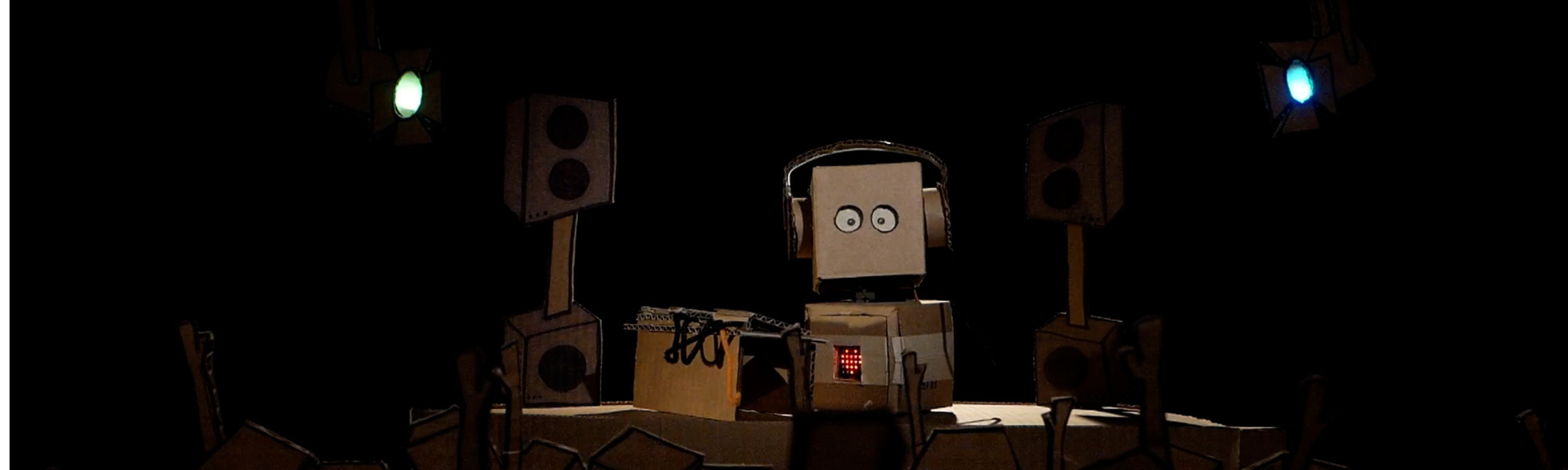
Elby’s got the mic, the lights, and absolutely no set list — the robot music festival, “Cardstock,” starts in minutes and he still hasn’t written a single song! Get ready for a behind-the-scenes find out how we turned Elby into a Robot DJ, our beat-dropping, buzzer-blaring dive with melody and code. Amanda Jeane sits down with Matt and Kelsey to talk about music, melody blocks, and a handful of cardboard puns that became CodeJoy’s very own music festival.
Amanda Jeane (AJ): What is Robot DJ?
Matt Chilbert (MC): Robot DJ is a show centered around music. In the show, Elby, our main character, is about to go on stage at the “CardStock Festival” (to play on Woodstock) but he doesn’t have any music ready to go. So the students need to quickly help him write some songs. They create those songs using a simplified melody building block that you can find in MakeCode to make the micro:bit make sounds.
AJ: What’s the big idea behind Robot DJ?
Kelsey Derringer (KD): This show uses music as an on-ramp to coding.
MC: This was I think our second or third show, but his was one of our most successful early shows because it didn’t require CodeJoy Live (our custom interactive website). Students could make code and they could send in little songs and then we would play those along. It was designed very early on even before we had the CodeJoy Live capabilities.
KC: It’s gone through a number of iterations too in terms of the music that the kids are coding along with. There’s a repetitive sort of EDM track that the kids then play their songs over the top of. It’s been fun to have different iterations of that first iteration. I think my friend Brendan made us a song and then we worked with a local musician here in Pittsburgh known as Middlechildren and they made us a song. But then once Bryce came on as our music director, we were able to give him more refined direction. We brought in music from a musician who we deeply respect, Harry Bellfonte, not a musician that a lot of kids know, but he sings “Day-o (Banana Boat song)”. He also sings “Jump in the Line (Shake, Senora)”.
We like his philanthropy and his humanitarian work that he did throughout his life. So there’s something for the adults who might know who Harry Bellfonte is. And, if kids end up looking into it anymore, that’s a person with whom our values are very deeply aligned. What Bryce had to do for that music though was he had to take these Harry Bellfonte songs and put them in a different key that matched with the key of micro:bit songs. One of the design principles behind all of our shows is that the kids have to be able to create something successful very quickly. In a music show, we needed it to sound good. And now in the show, the kids create the songs, we play the track that goes underneath, and then we cue the micro:bit songs to actually play over the top of that track. In a way, I guess that’s what DJs actually do. So in this respect, I think I’m the robot DJ.
AJ: What is one of your favorite elements of this show?
KD: One of my other favorite bits in this show is that Elby has to get on stage following another DJ, and it’s this really cool DJ named DJ Flora. She’s awesome and she has this awesome eyeliner. I just think she’s really cool and she’s playing this really awesome song. Elby is a little bit intimidated by that.
AJ: Where did the idea for Robot DJ come from?
MC: When we’re designing a show, we’re thinking both of a fun interaction for the kids and a unique entry point into robotics. The goal is always to engage kids that wouldn’t classically be engaged in robotics. Music seemed like a very universal starting point. While we’re not the first people to sort of pair up music and robotics, I think we’ve just created something really interesting here.
KD: There are all sorts of actual platforms that use music and coding. Hour of Code lessons have been making dance and music activities for years. I do want to give a special shout out to somebody else who we took some inspiration from. There is this artist named Captain Credible and he created this thing called the micro:bit Orchestra. It’s one of the weirdest things you’ve ever seen and we thought it was awesome. We in no way recreated that. Basically the micro:bit Orchestra allows one people during a live broadcast can create a sequence of noises and those noises are actually played on instruments. So a spoon hits a bowl, a fork hits a glass, something like that. Then he live DJs underneath it. So that is very much like a live interactive found object concert. It’s very cool.
What we’re doing is more like a story. There’s a show to it, but that is a really incredible creator that we took that we really admired as we were making this show.
AJ: Was there anything special about creating this show you’d like to share?
KD: One of the technical capabilities that we’ve created to go along with the show is that while the kids songs are playing, we wanted to cut to scenes of the robots dancing because they liked it. The robots in the crowd really like the music that the kids are creating. We want them to feel successful, right? And so we created a bunch of cutaway scenes that are triggered through our OBS, which is how we manage all of our video and everything. These cutaway scenes were really fun to imagine. So, what kinds of things happen at a music festival? Well there’s a big beach ball that gets thrown around, then there’s robots bobbing their heads, and one of the little robots crowd surfs! There’s a robot doing break dancing and spinning around on the ground, and there’s another robot holding up a phone and you see this shaky phone. So, there’s some really funny shots in this one, and it was really fun imagining what those cutaway scenes might be and then filming each of them. We had a lot of fun doing that in the garage back in 2020.
MC: From a technical standpoint, I don’t know if Mike had fun making the music interaction, but he certainly made it and it’s awesome. It’s a very unique dashboard in CodeJoy Live. It’s a unique dashboard that we only use for robot DJ that allows the kids to make music very similar to the melody block in MakeCode for micro:bit.
KD: Yeah, this show was created at a time where every single show we did was pushing our limits as a team and creating some new capability within Codejoy Live. So, the new thing in this show was that we could now get CodeJoy Live to play music and that was very fun and only slightly frustrating to get to work.
AJ: This show is paired with a lesson plan, Tiny Drummer, tell us what teachers can do with this in their classrooms.
KD: It uses a piece of cardboard, a popsicle stick, and a cup. If you don’t have a cup, use a pencil case. If you don’t have a popsicle stick, use a marker. If you don’t have a piece of cardboard, they can literally use whatever they have and it works. So the ways in which this project tends to not work initially are actually teaching tools for teaching them how a motor works. So it’s a really great instructional project that reinforces the concepts that we’re learning and really puts them into practice.
MC: I think the original attempt was to create something like a drummer or somebody that could bang on water glasses to make a little song. So perhaps it could rotate and hit different notes or something like that. But as we sort of experimented and brought this to teachers, the function of it was not the part of it that interested most people. In other words, it didn’t matter how well it drummed, or if it could play a song. Actually in some ways the more ridiculous you can make it, the more spectacularly it failed, the more fun it was. Just that the ability to inject humor and fun into any robotics project is that’s really one of the end goals for us here at CodeJoy.
KC: It’s just such a wildly adaptable project because music is such a universal human love. It was one of those projects that we created as a very easy entry point for teachers to try making a robotic thing with their kids. This project shows what can we do with very simple craft supplies and just one single output a motor.
In professional development, where we teach teachers to use the Hummingbird Robotics Kit, Tiny Drummer is a project we often do with teachers. This project illustrates what makes a good first robotics project and brings out that CodeJoy ethos in a lot of people that are new to the experience that we generate as a professional development providers.


Leave a Reply